
I landed at Ngurah Rai International Airport at 11 PM, buzzing with excitement and absolutely zero preparation. I'd watched the Instagram reels — infinity pools, green rice terraces, smoothie bowls — and figured that was all the research I needed. Within 48 hours, I had stepped on a religious offering, been quoted triple the real price for a taxi, and spent an uncomfortable night wondering if the ice in my cocktail was about to ruin my trip. Bali doesn't hand you a manual when you arrive. But after living here on and off for months, I've compiled the guide I desperately needed on day one. Here are the seven things I genuinely wish someone had grabbed me by the shoulders and told me before I walked out of that airport.
1. Those Airport Costs Add Up Fast
Everyone talks about the cheap flights to Bali, but almost no one mentions the entry fees that hit you before you even reach baggage claim. As of 2026, most visitors need an electronic Visa on Arrival (e-VoA), which costs IDR 500,000 — roughly USD $31 or AUD $48. You can pay online before you fly or at the airport counter, but the online option saves you from standing in a second queue after a long flight.
Then there's the Bali Tourist Levy — a separate IDR 150,000 (around USD $9) fee introduced to fund cultural and environmental preservation on the island. You pay this through the official Love Bali app or website, and you'll need to show the QR code at a dedicated checkpoint. Some travelers miss this entirely and get turned back at the counter, forced to fumble with their phone on airport Wi-Fi while a line forms behind them. Between the visa and the levy, you're down IDR 650,000 before you've even found your driver.
Also, download the SatuSehat app and complete your electronic customs declaration before you fly. The paper forms are gone, and the Wi-Fi at DPS is unreliable at best. A friend of mine spent 40 minutes refreshing the customs website on airport data while his driver waited outside, meter running.
2. Money Changers Are a Minefield
The first money changer I used was a brightly lit shop on a main street in Kuta with a giant "NO COMMISSION" sign out front. The rate on the board looked better than what Google showed. I handed over AUD $300 in crisp notes. The teller counted out a thick stack of rupiah, folded it, and handed it to me with a smile. I walked out feeling like I'd scored a deal.
Back at my guesthouse, I counted. I was short by about IDR 400,000 — roughly AUD $38. The old "sleight of hand while folding" trick works on tired tourists every single day. These shops don't survive on volume; they survive on tourists who don't double-check.
The safest approach: use ATMs attached to actual banks (BCA, Mandiri, BNI) and always reject the ATM's offered conversion rate — let your home bank handle the exchange. If you must use a money changer, go to an authorized one with a proper booth and a digital display, not a handwritten board. Count the money yourself at the counter, slowly, before you walk away. And never, ever change money at the airport — the rates there are genuinely terrible. I've seen airport counters offering IDR 14,500 to the dollar when the street rate was IDR 16,200. On a USD $500 exchange, that's a difference of IDR 850,000 — enough to cover three nights in a decent guesthouse.
3. You Probably Shouldn't Rent That Scooter
The scooter is practically the mascot of Bali travel content. Every influencer video shows someone cruising past rice fields with a sarong flapping in the wind. What they don't show: the police checkpoint 500 meters down the road where officers are pulling over every foreigner without an International Driving Permit.
Here's the reality in 2026: if you don't have an IDP endorsed for motorcycles from your home country, you're driving illegally. Indonesian police have ramped up enforcement significantly. A checkpoint stop typically costs IDR 100,000 to IDR 300,000 in "on-the-spot fines" — cash, no receipt — though official fines can reach IDR 1,000,000. Your travel insurance also won't cover you. A friend of mine from the UK got into a minor accident on a scooter in Canggu. No IDP meant his insurer rejected the claim. The hospital bill for a few stitches and an X-ray came to IDR 12,000,000 — about £600, which he paid out of pocket.
The roads themselves are another matter. Bali traffic is chaotic in a way that's hard to describe until you experience it. Scooters weave between cars, trucks pass on blind corners, and Google Maps might route you down a dirt path that dead-ends at a temple wall. If you're not an experienced rider at home, Bali is not the place to learn. Use Gojek or Grab for short trips (a 20-minute ride typically costs IDR 25,000–50,000) and hire a private driver for day trips — expect to pay IDR 500,000–700,000 for an 8-10 hour day, and that usually includes petrol.
4. The Tiny Offerings You Keep Stepping On
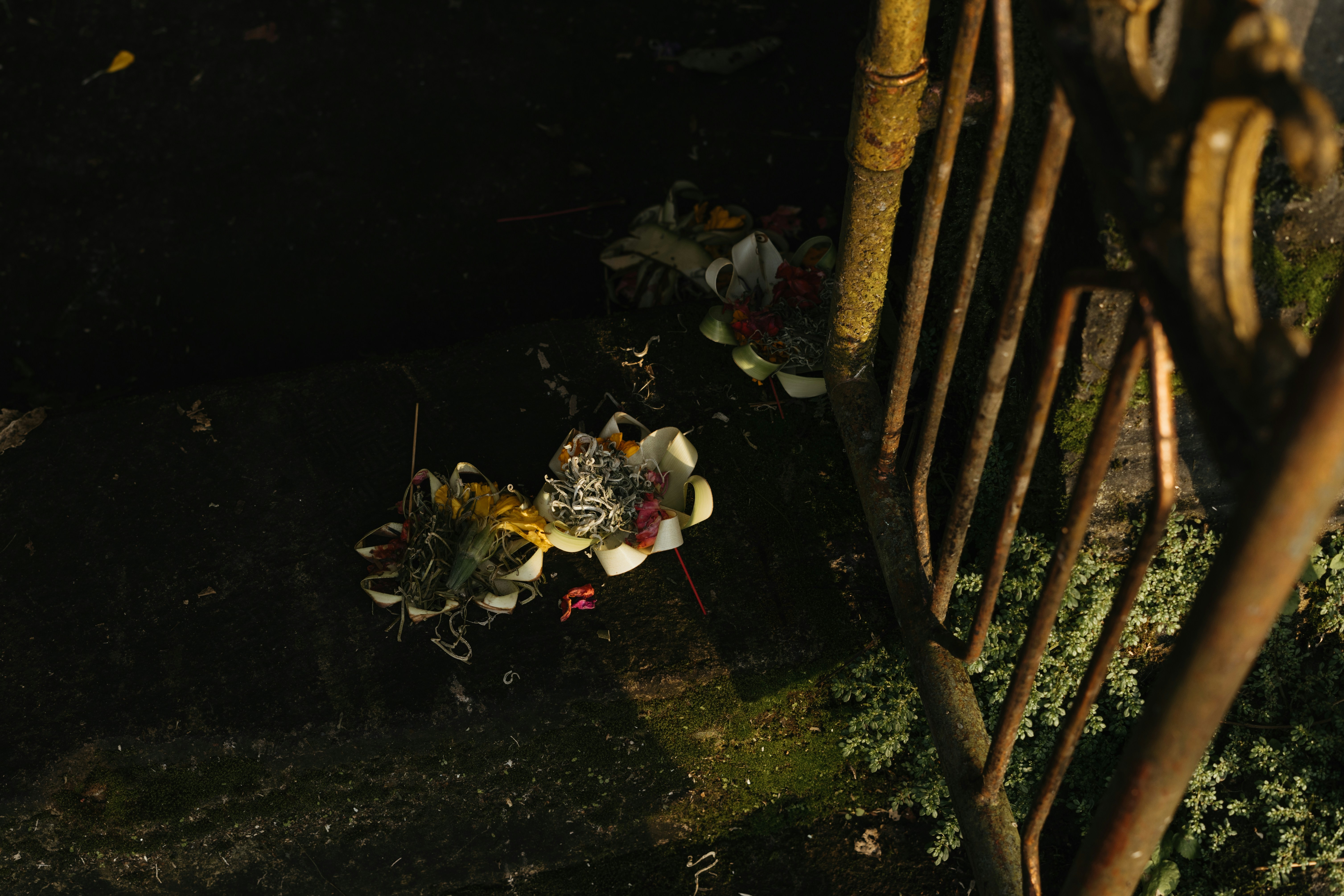
Within my first two hours in Bali, I had already committed the classic tourist offense: I stepped directly on a canang sari, the small square offering tray made of woven palm leaves filled with flowers, rice, and a burning incense stick. I didn't even notice until a local woman gave me a look that needed no translation.
Canang sari are placed on sidewalks, shop entrances, temple steps, and sometimes right in the middle of a walking path. They're not decoration. They're a daily Balinese Hindu ritual — an offering of gratitude to the gods, placed fresh every morning and sometimes again in the afternoon. The belief is that stepping on one is not just disrespectful but spiritually polluting. The proper response if you accidentally step on one: step back, offer a quiet apology (a small bow or hand gesture is enough), and walk around. Don't pick it up. Don't photograph it with your foot next to it for Instagram.
You'll also see larger offerings on certain days — tall stacks of fruit, whole roasted chickens, elaborate arrangements at temple entrances. These are for ceremonies. Give them space, don't touch anything, and if you want to take a photo, do it from a respectful distance. The Balinese are remarkably tolerant of tourists, but treating their religious practice as a photo prop is a quick way to wear out that goodwill.
5. "Bali Belly" Is Not a Myth
I'll spare you the graphic details, but let's just say I learned about Bali belly the hard way on day three. The culprit was almost certainly ice in a smoothie bowl from a café that looked spotless. The problem isn't always the water — it's often poor food handling, produce washed in tap water, or ice made from unfiltered sources.
The rule I follow now: eat where it's busy. A warung with a line of locals at lunchtime is serving food that hasn't been sitting around. The nasi campur at Warung Wardani in Denpasar, for example, has been drawing crowds for decades for a reason — the turnover is so high that nothing sits. Expect to pay IDR 35,000–60,000 for a full meal at a good local warung.
Stick to bottled or filtered water. Most accommodations provide refillable gallon dispensers. Brush your teeth with bottled water too — it sounds paranoid until you've spent a day within sprinting distance of a bathroom. Carry activated charcoal tablets (you can buy them at any Apotek or convenience store for about IDR 15,000) and an electrolyte solution. And if you do get sick, don't try to tough it out — a visit to a proper clinic like BIMC in Kuta or Ubud will cost IDR 500,000–1,500,000 depending on treatment, and it's worth every rupiah.
6. The Transport Mafia Is Real
The first time I tried to book a Grab from the airport, my driver called and told me to walk past the official taxi stand and meet him at a specific pillar in the parking garage. I thought he was being dramatic until I saw the group of men in matching shirts physically blocking a tourist from walking toward a waiting Grab car.
Certain areas in Bali have what locals euphemistically call "transport cooperatives" — essentially taxi cartels that have carved out territories where ride-hailing apps are banned or aggressively blocked. The airport is one. The main drop-off at Uluwatu's beaches is another. Parts of central Ubud, the entrance to Tanah Lot, and several big hotel zones also have restrictions. In these areas, you're stuck with the local drivers, and they know it. A trip that would cost IDR 60,000 on Grab might be quoted at IDR 250,000 by a local driver.
The workarounds: at the airport, walk to the domestic terminal or the parking area to catch your ride-hailing pickup. At Uluwatu, walk a few hundred meters down the road away from the official entrance. In Ubud, book a driver for the whole day rather than getting stuck in a taxi black hole. A full-day driver for IDR 600,000 is often cheaper than three or four individual taxi trips at inflated rates.
7. Pick Your Area Carefully — Or You'll Regret It
Bali looks small on a map, but getting from Canggu to Uluwatu can take two hours in traffic. The island's regions are completely different experiences, and picking the wrong base for your trip is the single most common regret I hear from other travelers.
Canggu is where the digital nomads and surfers congregate. It's dense, loud, traffic-clogged, and packed with excellent cafés and co-working spaces. A smoothie bowl costs IDR 70,000–110,000, and a private villa runs IDR 800,000–2,500,000 per night. It's fun, but it's also the place where you'll sit in scooter traffic for 20 minutes to go two kilometers.
Ubud is the cultural heart — temples, yoga studios, rice field walks, and a slower pace. A guesthouse near the Monkey Forest goes for IDR 300,000–700,000, and you can eat well at a local warung for IDR 40,000–60,000. The downside: Ubud's center is now heavily commercialized, and the famous Campuhan Ridge Walk can feel more like a shopping mall queue during peak season.
Uluwatu is all cliffs, surf breaks, and dramatic ocean views — but everything is spread out and you absolutely need your own transport or a driver. Sanur is quieter, flatter, and popular with families and older travelers. Jimbaran has the seafood dinners on the sand (expect IDR 300,000–600,000 for two people at the beach grills) and is close to the airport. Seminyak offers higher-end shopping and dining but comes with brutal traffic on the main strip.
My honest advice: don't try to cover the whole island in a week. Pick two areas max. Three nights somewhere central like Ubud, then three nights by the coast. Anything more ambitious and you'll spend half your trip staring at the back of a scooter helmet in traffic.
Bali rewards the prepared traveler. It doesn't demand perfection — the Balinese are some of the most patient people you'll ever meet — but a little knowledge goes a long way. Know what you'll pay at the airport, count your rupiah, respect the offerings on the ground, and think twice before you hop on a scooter with no license. Get those things right, and the rest of the island opens up to you in ways the Instagram reels never quite capture.
Recommended Booking
Book via our trusted partner: Find hotels near Kuta & Legian — Agoda
Essential Gear
Don't leave home without it: Bali airport transfers & day tours — Klook
Written by Kai
Born in Jimbaran to a Balinese mother and Australian father. Resident on the island since 1988.